
PN25

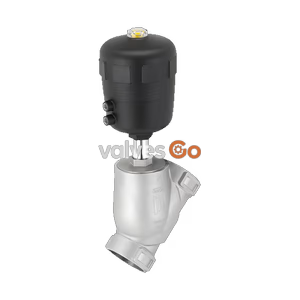
Burkert Type 2106 (SKU 20063357) pneumatically operated 3/2-way seat valve. Features stainless steel body, PTFE seal, PN16, and decentralized automation.
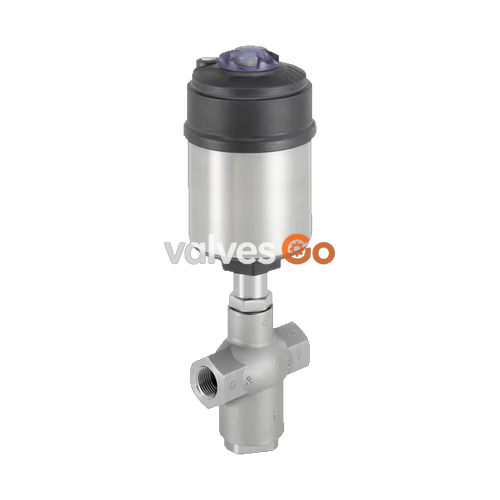
Burkert Type 2106 (Article No. 20063357) is a pneumatically operated 3/2-way seat valve ELEMENT designed for decentralized automation. It consists of a pneumatically operated ELEMENT actuator and a 3-way stainless steel valve body. Interchanging of pressure and service ports enables different fluidic circuit functions, such as the mixing or distributing of mediums. The flow-optimized valve body of Type 2106 allows excellent flow rates. The tried and tested self-adjusting gland secures a high level of tightness and thus ensures reliable operation over years.
The design of the 3/2-way valve offers all the advantages of modern, decentralized automation: The directly connected control head and actuator provide a compact and smooth design, integrated pneumatic lines, protection class IP65/67, NEMA Type 4X, and high chemical resistance. For the user, the compact Type 2106 is often an economical alternative to two single valves.
| Property | Value |
|---|---|
| Body Material | Cast stainless steel 316L |
| Actuator Material | PPS |
| Seal Material | PTFE |
| Cover Material | Stainless steel 1.4561 (316Ti) |
| Spindle Packing | PTFE seal with spring compensation |
| Nominal Diameter | DN 15...DN 50, NPS 1/2...NPS 2 |
| Nominal Pressure | PN 16 (body) |
| Pilot Pressure | Max. 10 bar(g), actuator size Ø 130 mm, 7 bar(g) |
| Medium | Steam, water, neutral gases, alcohols, oils, fuels, hydraulic fluids, salt solutions, alkalis, organic solvents, oxygen and fuel gases |
| Medium Temperature | -10 °C...+185 °C |
| Viscosity | Max. 600 mm²/s |
| Control Medium | Air, neutral gases |
| Ambient Temperature | -10 °C...+60 °C (integrated control unit) -10 °C...+100 °C (push-in air ports) |
| Installation Position | As required, preferably with actuator in upright position |
| Symbol | Description |
|---|---|
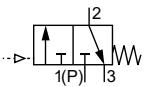 | Control function C (CF C) Pneumatically operated 3/2-way process valve. When de-energised, pressure port 1 closed, service port 2 exhausted. |
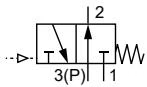 | Control function D (CF D) Pneumatically operated 3/2-way process valve. When de-energised, pressure port 3 connected to service port 2, exhaust port 1 closed. |
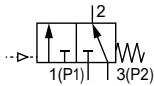 | Control function E (CF E) Pneumatically operated 3/2-way mixer valve. When de-energised, pressure port 3 connected to service port 2, pressure port 1 closed. |
| Control function F (CF F) Pneumatically operated 3/2-way distributor valve. When de-energised, pressure port 2 connected to service port 3, service port 1 closed. |
Note on Control Function A
For Actuator with Control function A: When de-energised port connection 1 is closed with spring.
| Fluidic circuit function | Connection 1 | Connection 2 | Connection 3 |
|---|---|---|---|
| C | P | A | R |
| D | R | A | P |
| E | P1 | A | P2 |
| F | A | P | B |
(A, B = Service ports; P, P1, P2 = Pressure ports; R = Exhaust port)
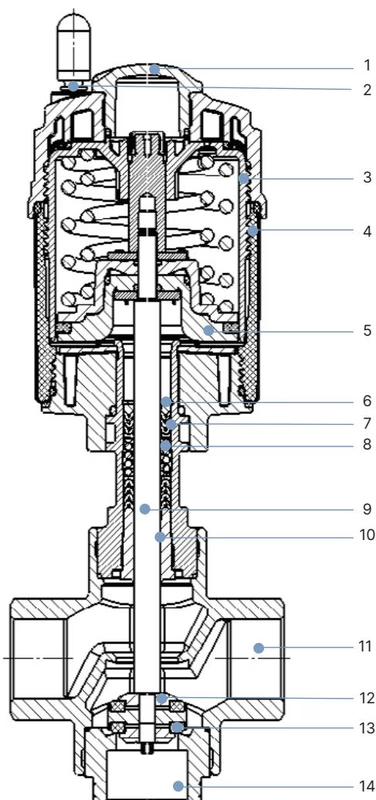
| No. | Element | Material |
|---|---|---|
| 1 | Transparent cap | Polysulfone PSU |
| 2 | Pilot air ports | Push-in connector PP (standard) / Thread G 1/8" stainless steel 1.4305 (on request) |
| 3 | Actuator cover | PPS |
| 4 | Actuator casing | Stainless steel 1.4561 (316Ti) |
| 5 | Piston seal | FKM |
| 6 | Spring | Stainless steel 1.4310 |
| 7 | Tube | Stainless steel 1.4401 (316)/1.4404 (316L) |
| 8 | Packing gland | PTFE |
| 9 | Spindle | Stainless steel 1.4401 (316)/1.4404 (316L) |
| 10 | Spindle guide | PEEK |
| 11 | Valve body | Stainless steel 1.4404 (316L) |
| 12 | Body closer | Stainless steel 1.4404 (316L) |
| 13 | Seal | PTFE |
| 14 | Seat nipple | Stainless steel 1.4404 (316L) |
INFO
The lubricants for packing gland and actuator are classified according to NSF H1.
Actuator size Ø 50 mm (Maximum control pressure 10 bar(g))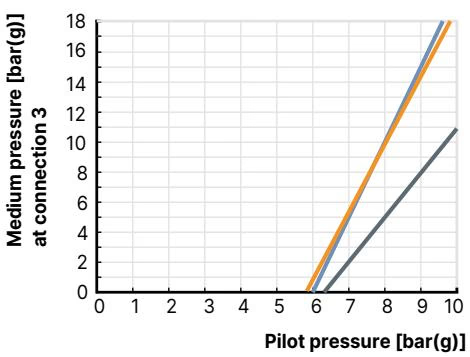
Actuator size Ø 70 mm (Maximum control pressure 10 bar(g))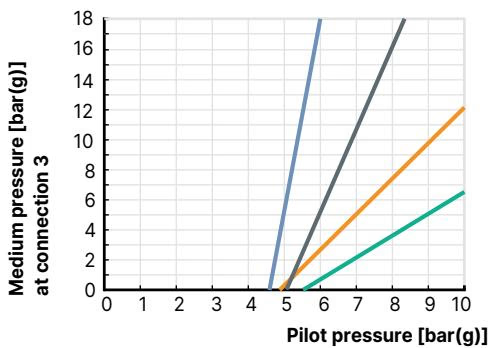
The seat valve Type 2106 can be combined with the position feedback Type 8690/8697 and the control head Type 8691/8695 to form the valve system On/Off ELEMENT Type 8801-GE.
When using the device in potentially explosive areas (Zones 1/21 and 2/22), special conditions apply for devices marked with PX51.
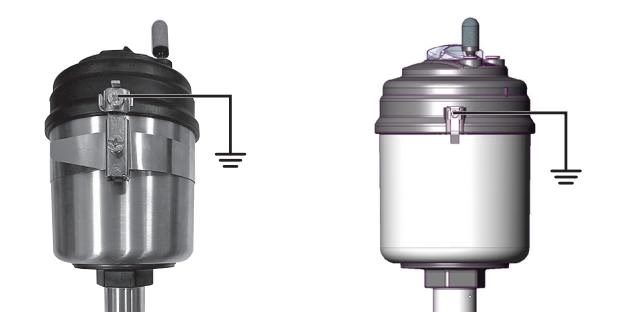
Explosion Hazard due to Electrostatic Charging!
If statically charged equipment or persons discharge suddenly, there is a risk of explosion in the potentially explosive area.
| Temperature Class | T2 | T3 | T4 |
|---|---|---|---|
| Max. Surface Temperature | 300 °C | 200 °C | 135 °C |
| Ambient Temperature | -40 to 130 °C | -40 to 130 °C | -40 to 100 °C |
| Max. Medium Temperature | 285 °C | 185 °C | 125 °C |
Cleaning in Potentially Explosive Areas
Cleaning agents can cause an explosion risk. Only use cleaning agents certified for use in explosive environments.
Explore similar products in our catalog