
Skip to content
Energy EfficientPrecise ControlLow Maintenance

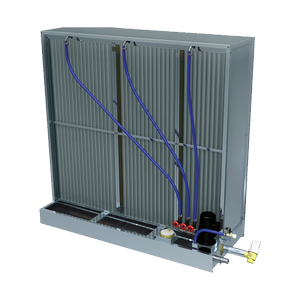
Armstrong Cool Fog® 雾化加湿器 Cool Fog® Atomizing Humidifier

Armstrong Cool Fog® systems use compressed air and pressurized water for efficient atomization. Features precise control, low maintenance, and high reliability for commercial and industrial humidification.
Armstrong Cool Fog® 雾化加湿器 Cool Fog® Atomizing Humidifier

Armstrong Cool Fog® Systems are humidification systems that atomize water particles to produce a fog. When the fog is sprayed into a warm, dry air stream or space, the water readily evaporates without the addition of heat. The process is also referred to as evaporative humidification and follows the wet bulb line (i.e., constant enthalpy) on the psychrometric chart. Armstrong-Cool Fog Systems may also be used for the purpose of air-cooling. Because no heat is added to evaporate the water, there is a cooling effect that is directly proportional to the amount of water evaporated.

How Foggers Operate

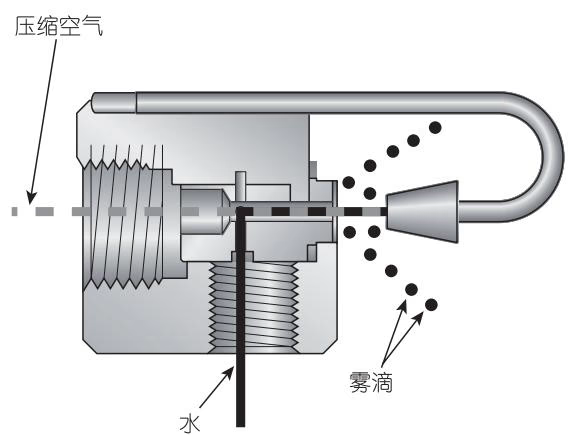
Armstrong-Cool Fog Systems use both compressed air and pressurized water to achieve atomization. Pressurized water is injected into the discharge orifice of a compressed air stream. As the compressed air is discharged through an orifice, the air’s potential energy is converted to kinetic energy, which is imparted to the injected water. In the process, the water is sheared into atomized water particles.

The mixture of atomized water and expanding air is discharged through an orifice and deflected off a resonator tip which further reduces the water particle size and spreads the atomized water and air mixture. The final product is fog.
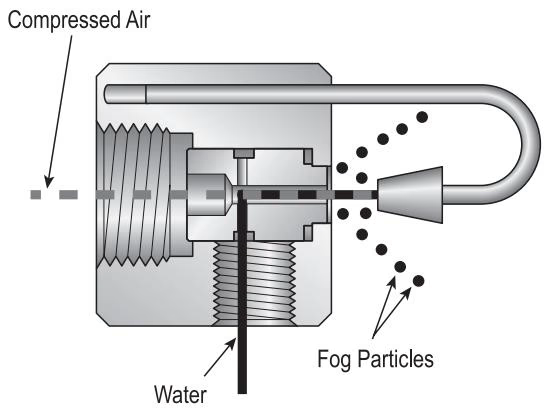
Armstrong Cool Fog® 雾化加湿器 Armstrong Cool Fog® Humidifier fogger head operation diagram

Available System Types

  • Cool Fog Systems (CF): For use with potable or reverse osmosis purified water. All wetted parts are either stainless steel, brass, or copper. For general commercial and industrial application.
  • Pure Fog Systems (PF): For use with de-ionized water. All wetted parts are stainless steel. For clean rooms, laboratories, semiconductor fabs, and other ultra clean environments.
  • Standard Proportional Systems (STD): For air handler or duct applications. Available as CF or PF. For reduced evaporation distance requirements with medium to high compressed air consumption rates and 50:1 control modulation.
  • Variable Differential Control Systems (VDC): For air handler or duct application. Available as CF or PF. For reduced compressed air consumption rates and 100:1 control modulation.
  • HumidiComp (HC), ON/OFF SYSTEMS: For air handler or duct applications. Available as CF or PF. For reduced cost compared to STD and VDC.
  • Direct Area Discharge (DDF), ON/OFF SYSTEMS: For direct area discharge. Available as CF or PF.

Energy Savings & Benefits

Efficient use of internal heat gain and waste heat can yield up to a 90% reduction of energy costs compared to steam humidification. Key energy-saving opportunities include:

  1. Latent Heat Recovery from Return Air: Uses warm return air to evaporate water without the energy required to boil water.
  2. Reduction in Humidification Load: Less outside air is used with evaporative humidification, reducing the overall humidification load.
  3. Mixed Air Cooling Savings: Achieves free cooling when outside air temperature is above the dry bulb temperature and below the dew point of the supply air.
  4. 100% Make-up Air Cooling Savings: Substantial energy savings in hot and dry climates with evaporative cooling systems.
  5. Pre-Cooling of Inlet Air: Evaporative pre-cooling of air-cooled water coils or gas-fired turbines presents substantial energy savings over mechanical refrigeration.

Installation & Start-Up

Danger: Electrical Shock Hazard!

Disconnect Power to Control Panel Before Installing or Servicing.

Resonator Installation and Adjustment

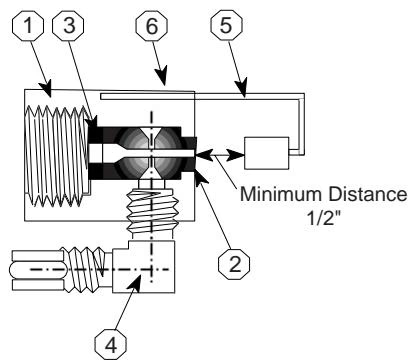
Install one resonator per fogger head allowing approximately 1/2" of clearance between the fogger head and the resonator face. Align the resonator so that the orifice of the fogger head is directly in front of the resonator face.

NoteDescriptionMaterial
1Body (1.25" O.D.)316 Stainless Steel
2Orifice (2A)316 Stainless Steel
3GlandTeflon
4Water Connector316 Stainless Steel
5Resonator Assembly316 Stainless Steel
6Set Screw (Allen HD)18-8 Stainless Steel

Armstrong Cool Fog® 雾化加湿器 Armstrong Cool Fog® Humidifier resonator installation and components

Maintenance & Troubleshooting

Fogger Head Cleaning (Removal of Debris)

  1. Remove the resonator.
  2. Remove compression fittings.
  3. Remove the male connector from the back of the fogger head.
  4. Remove sealing gland, orifice and slip seal.
  5. Flush the fogger head and orifice with compressed air.
  6. Place the slip seal back on the orifice and insert in the fogger head.
  7. Place the sealing gland back in the fogger head.
  8. Reinstall the male connector, reassemble the fogger head, and reinstall the resonator.