
Up to 99.8% Efficiency

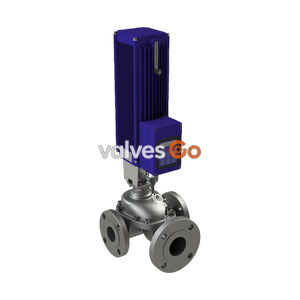
Burkert 20023660 Type 2861 direct-acting 2-way proportional valve. Features a 0.8 mm orifice, stainless steel body, FKM seal, and flange connection. Suitable for neutral gases and liquids up to 12 bar.
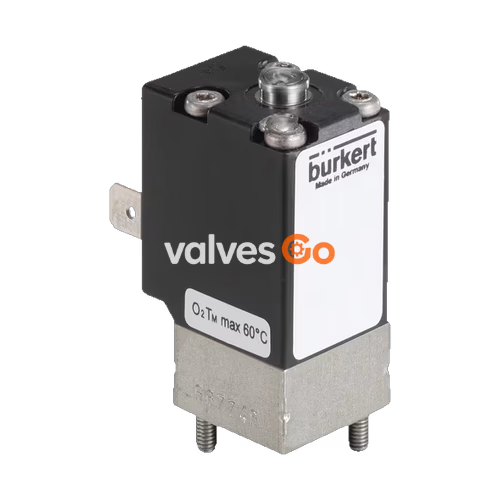
Burkert 20023660 Type 2861 is an extremely compact direct-acting 2-way solenoid proportional control valve. It features an orifice of 0.80 mm and is based on the standard variant of Type 2871. It is used as an actuator in closed control loops (pressure, flow, temperature, etc.). Compared with the standard variant, the valve is essentially of simpler construction and assembly and testing procedures are optimized, easing high volume series production with shorter delivery times.

| Product properties | |
|---|---|
| Seal material | FKM |
| Body material | Stainless steel |
| Circuit function | A (2/2-way solenoid proportional control valve, Direct-acting, Normally closed) |
| Hysteresis | < 5% |
| Repeat accuracy | < 1% FS |
| Response sensitivity | < 1% FS |
| Setting range | 1:25 |
| Actuating time (10...90%) | < 15 ms |
| Pressure range | -1...12 bar |
| Operating voltage | 24 V DC |
| Power consumption | Max. 5 W |
| PWM frequency | 800 Hz |
| Operating medium | Neutral gases, liquids on request |
| Medium temperature | -10 °C...+90 °C (with FKM) |
| Degree of protection | IP65 |
Note
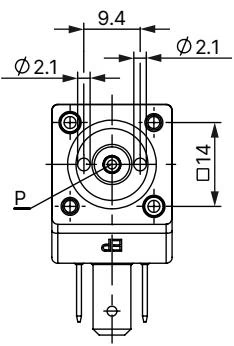
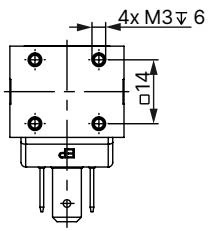
Dimensions are in mm.
Sub-base body
Threaded body G 1/8, NPT 1/8
Characteristic Curve Note
The dimensioning of the nominal diameter is very important for proportional valves to function properly within the application. The nominal diameter must be selected so that, on the one hand, the desired flow range is achieved and, on the other hand, when the valve is fully open, a sufficient portion of the total pressure drop occurs across the valve.
Reference value: Δp valve > 25% of the total pressure drop.
Otherwise, an ideal, linear valve characteristic is deformed into a curved system characteristic. If the differential pressure (difference between inlet and outlet pressure) exceeds half the value of the nominal pressure discontinuities may occur.
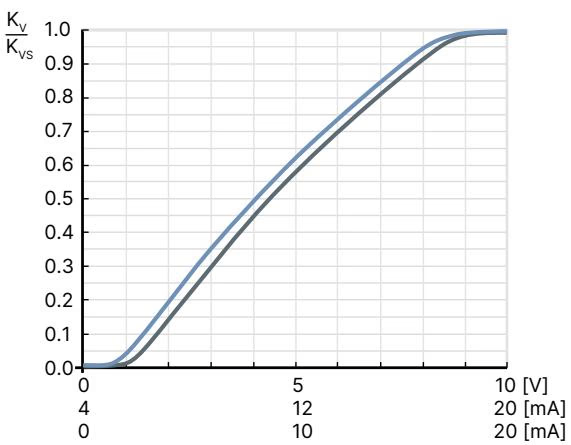
Valve control takes place through a PWM signal (pulse-width modulation). The duty cycle of the PWM signal determines the coil current and hence the position of the plunger.
The Bürkert control electronics Type 8605 converts an analogue signal to a reference value corresponding to the valve type PWM signal and provides additional functions such as temperature compensation (coil heating), ramp function and the adjustment of minimum and maximum duty cycle/coil current for the control range.
Explore similar products in our catalog