Type 2032

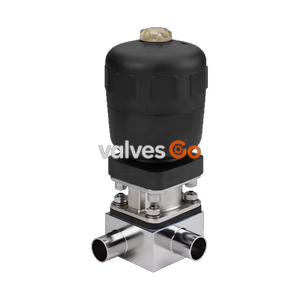
BURKERT 20085151 (Type 2933) 2/2-way manual diaphragm valve. Features DN 25 welded connection, 316L stainless steel tube body, EPDM diaphragm, and PPS handwheel. Suitable for hygienic applications up to 10 bar and 143°C.
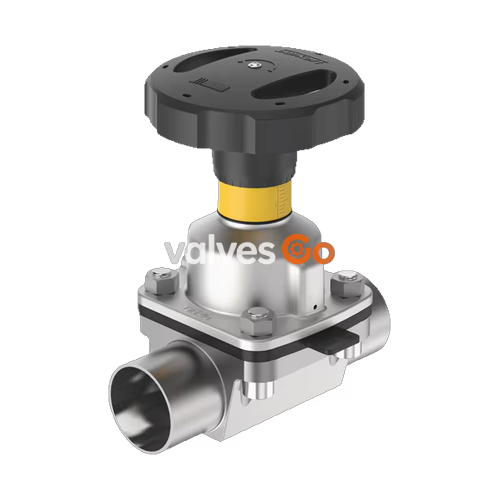
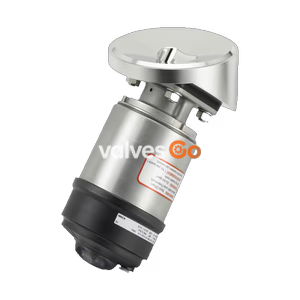
The BURKERT 20085151 (Type 2933) is a 2/2-way manually operated diaphragm valve designed for hygienic and sterile applications. It consists of a manually operated actuator with a PPS handwheel, an EPDM high-temperature diaphragm, and a flow-optimized 316L stainless steel tube valve body with minimum dead space. The manual actuator features a compact, autoclavable design and is equipped with an integrated visual position indicator, a reproducible stroke scale, and an adjustable closing limiter. This specific configuration features a DN 25 welded connection and is suitable for neutral gases and liquids, highly purified, sterile, or aggressive media up to 10 bar and 143 °C.
| Feature | Specification |
|---|---|
| Valve body material | Stainless steel tube 1.4435-BN2 / UNS S31603 (316L) according to DIN 11866, ASTM A269 / A270, DIN EN 10217-7 / 10216-5 |
| Diaphragm material | EPDM high-temperature (AD) |
| Actuator material | Handwheel: PPS; Diaphragm bonnet: Stainless steel |
| Standard surface quality | Internally electrically polished: Ra ≤ 0.38 μm (ASME BPE SF4 / DIN HE4); Externally electrically polished |
| Operating medium | Neutral gases and liquids, highly purified, sterile, aggressive or abrasive mediums |
| Medium temperature | -10...+143 °C (steam sterilisation +150 °C for 60 min) |
| Ambient temperature | -10...+130 °C (short-term up to +150 °C), autoclavable |
| Port connection | Welded connection (DIN 11850-2 / DIN 11866 series A / DIN EN 10357 series A) |
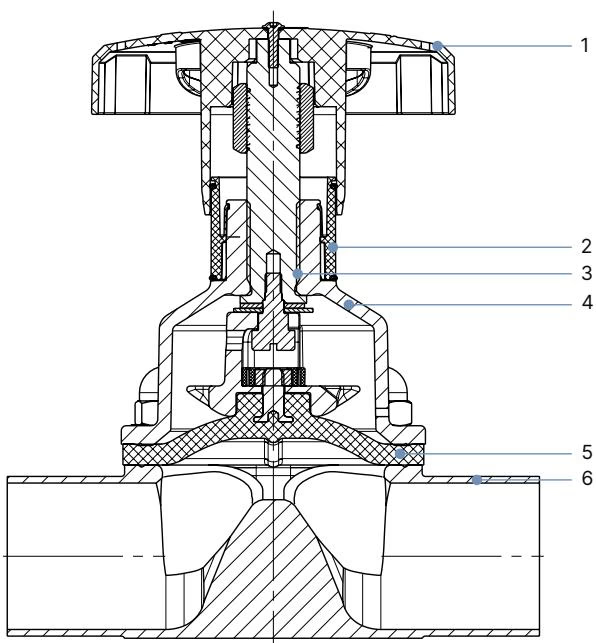
| No. | Element | Material |
|---|---|---|
| 1 | Handwheel | Polyphenylene sulphide (PPS) |
| 2 | Visual position indicator | Polyamide (PA), Stainless steel 1.4305 |
| 3 | Valve spindle | Stainless steel 1.4305 |
| 4 | Diaphragm bonnet | Stainless steel 1.4308 |
| 5 | Diaphragm | EPDM (AD) |
| 6 | Valve body | Stainless steel tube 316L/1.4435 BN2 |
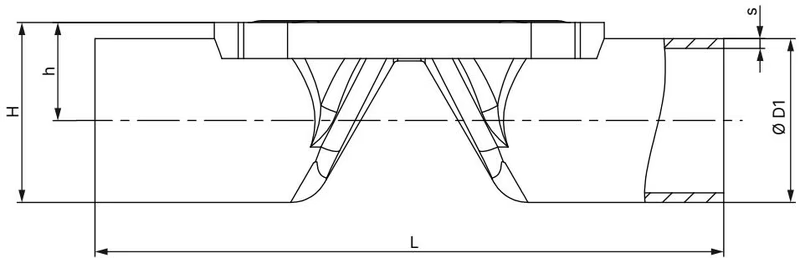
DIN 11850-2 / DIN 11866 series A / DIN EN 10357 series A
| Diaphragm size | Port connection DN | ∅D1 | s | L | h | H | Product key |
|---|---|---|---|---|---|---|---|
| 15 | 15 | 19 | 1.5 | 110 | 13.20 | 22.7 | SD42 |
| 15 | 20 | 23 | 1.5 | 119 | 15.20 | 26.7 | SD43 |
| 20 | 25 | 29 | 1.5 | 129 | 18.20 | 32.7 | SD44 |
| 25 | 32 | 35 | 1.5 | 148 | 21.20 | 38.7 | SD45 |
(Note: Dimensions in mm. The 20085151 model corresponds to Diaphragm size 20, DN 25).
| Diaphragm size | Port connection DN | Kv value water [m³/h] |
|---|---|---|
| 20 | 25 | 14.9 |
(Note: Flow rate Kv value water for elastomer diaphragms. Measurement at +20 °C, 4 bar at valve inlet and 3 bar at valve outlet).
| Diaphragm size | Maximum static operating pressure [bar] | Tightening torque for max static pressure (EPDM) [Nm] |
|---|---|---|
| 20 | 10 | 0.9 |
WARNING
The tightening torques refer to the static media pressures specified above. Excessive torque can shorten the service life of the diaphragm. A tolerance of +10% applies to the tightening torques specified.
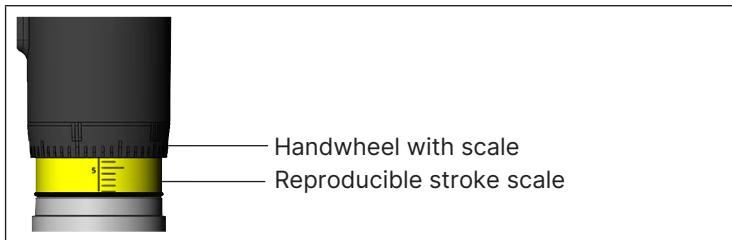
Turning the handwheel counterclockwise reveals the yellow position indicator and the scale marked on it as the valve opens further. The scale on the handwheel determines the rotation position of the handwheel (30 positions). The stroke scale shows the relative position of the valve and serves as a fixation point for determining the rotation position.
A minimum stroke limit can be set for Type 2933. This setting also serves as a closing limiter to protect the diaphragm. A hexagon nut is used to do this.
TIP
To protect the actuator, we recommend not closing the actuator with more force than is required to close the valve tightly.
Explore similar products in our catalog