PN16

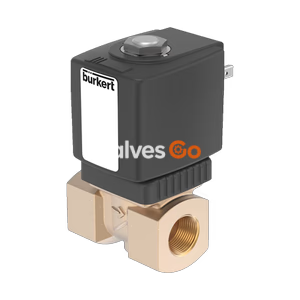
Burkert Type 2873 (SKU 327402) direct-acting 2-way proportional solenoid valve. Features 4.0mm orifice, FKM seal, stainless steel body, G 1/4 thread, and 24V DC operation.
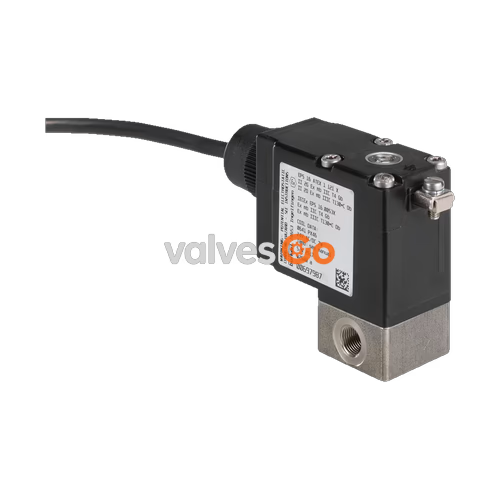
Burkert Type 2873 (Article No. 327402) is a direct-acting 2-way standard solenoid control valve used as the regulating unit in control loops. Due to an elastomeric seat seal, the valve closes tight (integrated shut-off function) up to the DN specific nominal pressure. The plunger of the valve is assembled frictionless, which leads to an extraordinary adjustment characteristic. This valve is particularly suitable for demanding control tasks, including high control ranges and dry gases.

| Property | Value |
|---|---|
| Circuit Function | A - normally closed - inlet port 1 (P/NC) |
| Body Material | Stainless steel |
| Seal Material | FKM (Fluor rubber) |
| Port Connection | G 1/4 Internal thread |
| Orifice Size | 4.0 mm |
| Operating Voltage | 24 V DC |
| Pressure Range | -1 to 2 bar (Differential pressure max: 2 bar) |
| Medium Temperature | -10 °C to +90 °C |
| Ambient Temperature | -10 °C to +55 °C |
| Kv Value (Water) | 0.32 m³/h |
| QNn Value (Gas) | 345 l/min |
| PWM Frequency | 600 Hz (min) to 800 Hz (max) |
| Degree of Protection | IP65 (with suitable connector) |
Determination of the Kv value:
| Pressure drop | Kv value for liquids [m³/h] | Kv value for gases [m³/h] |
|---|---|---|
| Sub-critical $p_2 > \frac{p_1}{2}$ | $= Q \sqrt{\frac{\rho}{1000\Delta p}}$ | $= \frac{Q_N}{514}\sqrt{\frac{T_1\rho_N}{p_2\Delta p}}$ |
| Supercritical $p_2 < \frac{p_1}{2}$ | $= Q \sqrt{\frac{\rho}{1000\Delta p}}$ | $= \frac{Q_N}{257p_1}\sqrt{T_1\rho_N}$ |
Note: $T_1$ in Kelvin [(273 + t) K]. Absolute pressure is used for calculations.
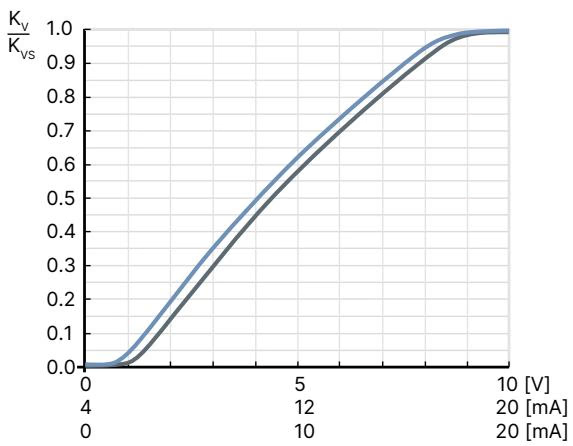
Note on Sizing
The dimensioning of the nominal diameter is very important for proportional valves to function properly within the application. The nominal diameter must be selected so that the desired flow range is achieved and, when the valve is fully open, a sufficient portion of the total pressure drop occurs across the valve. Reference value: $\Delta p_{valve} > 25%$ of the total pressure drop.
Control Unit Recommendation
Valve control takes place through a PWM signal (pulse-width modulation). The duty cycle of the PWM signal determines the coil current and hence the position of the plunger. The Bürkert control electronics Type 8605 converts an analogue signal to a reference value corresponding to the valve type PWM signal and provides additional functions such as temperature compensation (coil heating) and ramp functions.
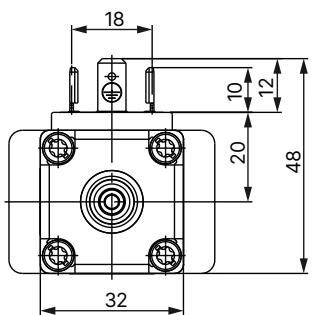
Dimensions in mm. For G 1/4 thread, dimension A is G 1/4 and dimension B is 12 mm.
When equipped with the optional Type 06xx explosion-proof coil, the device is suitable for potentially explosive areas.
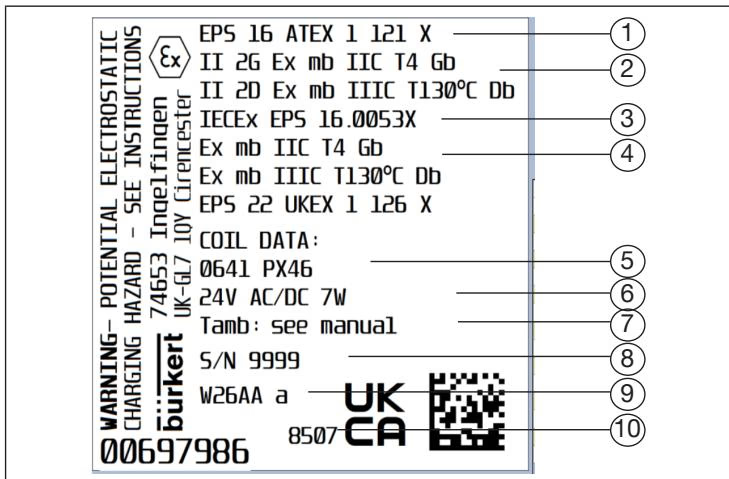
Basic Safety Instructions
Explore similar products in our catalog