
Energy Efficient

BURKERT 559616 Type 8222 conductivity transmitter. ELEMENT standard variant, PVDF union nut, C=0.1 cm-1 cell constant, 4-20 mA output, for clean water and slightly concentrated liquids.
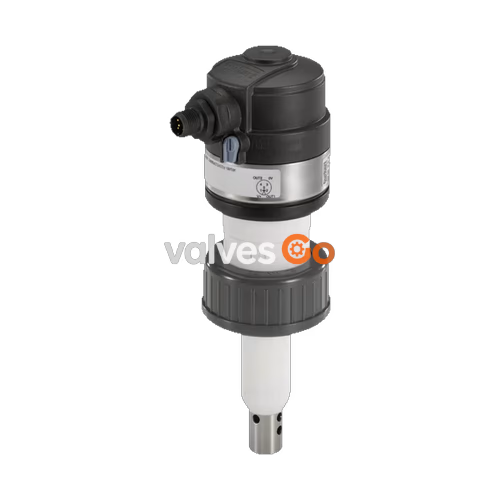
BURKERT 559616 Type 8222 conductivity transmitter is designed for measuring the conductivity of liquids. The sensor element comprises a two-electrode cell and a Pt1000 temperature probe. The sensor itself is available with three different cell constants C. Sensors with C=0.01 or 0.1 cm-1 are fitted with stainless steel electrodes, while those with C=1.0 cm-1 are fitted with graphite electrodes. Thanks to the design of the measuring device, Bürkert has simplified installation and maintenance work.
The Type 8222 device is available in two variants. The ELEMENT standard variant (which includes model 559616) is proposed with either three adjustable outputs (two digital outputs and one analogue output) or four adjustable outputs (two digital and two analogue), and can be equipped with a display. The display is only required for start-up, configuration (e.g. measuring range, units, calibration, limit values) and for process value display. The ELEMENT neutrino variant is a 2-wire device without display, equipped either with a 4...20 mA current output or with a digital communication mode via IO-Link or büS (Bürkert system bus based on CANopen).
| Feature | Specification |
|---|---|
| Wetted parts | |
| Probe holder | PVDF, stainless steel 1.4571 (316Ti) |
| Electrode | C = 0.01/0.1 cm-1: stainless steel 1.4571 (316Ti) C = 1 cm-1: graphite |
| Compatibility | With any pipe which is fitted with Bürkert S022 adapter |
| Pipe diameter | DN 32...DN 110 (DN 06...DN 25 under specific conditions) |
| Temperature sensor | Pt1000 integrated within the probe holder |
| Measuring range | |
| Conductivity measurement | 0.05 μS/cm...10 mS/cm |
| Temperature measurement | -20...+100 °C |
| Performance data | |
| Measurement deviation | ±3% of measured value (Conductivity), ±1°C (Temperature) |
| Measuring range resolution | 1 nS/cm |
| Electrical data | |
| Power source | Limited power source according to UL/EN 62368-1 standards |
| DC reverse polarity protection | Yes |
| Overvoltage protection | Yes |
| Medium data | |
| Fluid temperature | G 1½ PVC union nut: 0...+50 °C G 1½ PVDF union nut: -20...+100 °C (restricted by adapter) |
| Fluid pressure | Max. PN 16 |
| Environment and installation | |
| Ambient temperature | Operation and storage: -10...+60 °C |
| Relative air humidity | ≤85%, without condensation |
| Degree of protection | IP65, IP67 (according to IEC/EN 60529) |
WARNING
If the device is mounted in a humid environment or outside, then the maximum voltage allowed is 35 V DC instead of 36 V DC.
ELEMENT standard variant (C = 1 cm-1)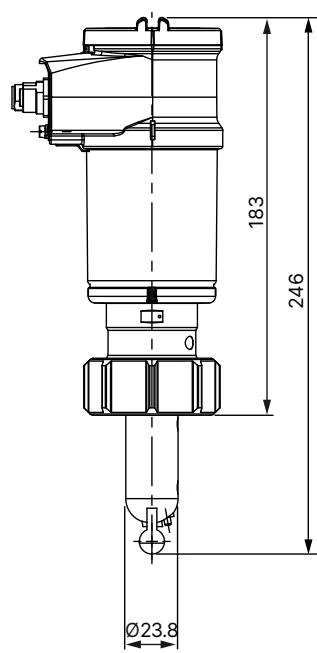
ELEMENT standard variant (C = 0.1 cm-1)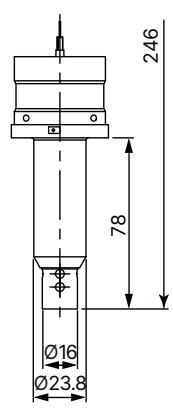
Pressure temperature diagram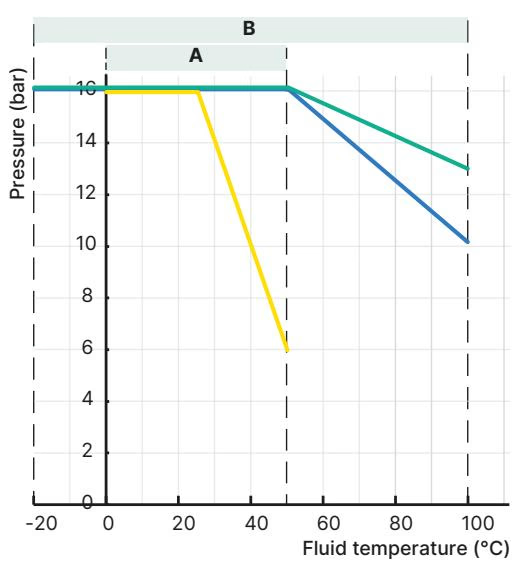
Conductivity is defined by the property of a solution to conduct electrical current. The charge carriers are ions (e.g. dissolved salts or acids). Regarding this device, the measuring cell consists of two metal electrodes which are set at a fixed distance apart and with a known specific surface. The measured current is a direct function of the quantity of ions contained in the solution. The conductivity is calculated using Ohm’s law.
To compensate for the geometry of the conductivity cell, a cell constant is used: Conductivity [S/cm] = Measurement [S] x Cell constant [1/cm].
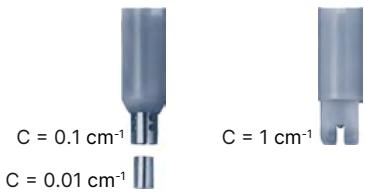
The sensor is selected according to the measuring range and medium. The meter is either a two wire device or a three wire device which requires a power supply of 14 V DC or 12 V DC up to 36 V DC and delivers a 4…20 mA standard signal proportional to the conductivity and/or to the temperature of the fluid as output signal.
The ELEMENT Type 8222 conductivity meter can be installed into any adapter/fitting with a G 1½ external threaded sensor connection by simply tightening the G 1½ union nut. Select the appropriate adapter, taking into account the specific requirements of the measuring device and the adapter material (temperature and pressure), and install it on a pipe.
TIP
In order to obtain reliable measurements, air bubbles must be avoided. Ensure that the mounting location provides a continuous and complete immersion of the probe in the flow stream.
Explore similar products in our catalog