Type 2032

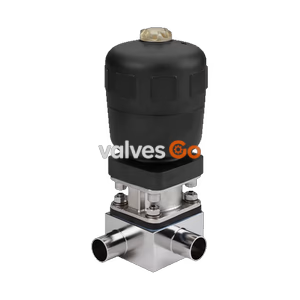
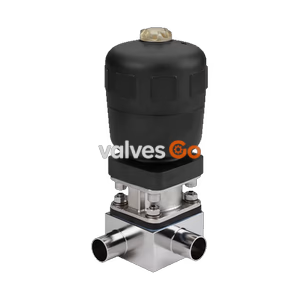
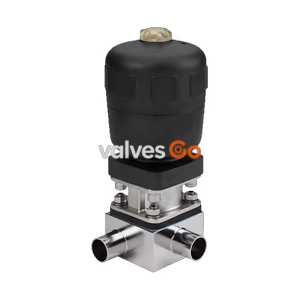
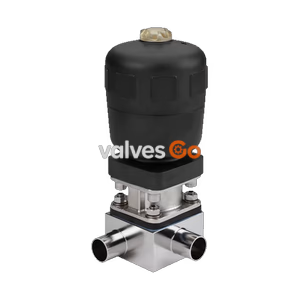
BURKERT 333947 (Type 2032) is a pneumatically operated 3/2-way T-diaphragm valve with stainless steel block body, PPS actuator, PTFE/EPDM seal, NC function, and ASME BPE DN 50/15 weld ends.
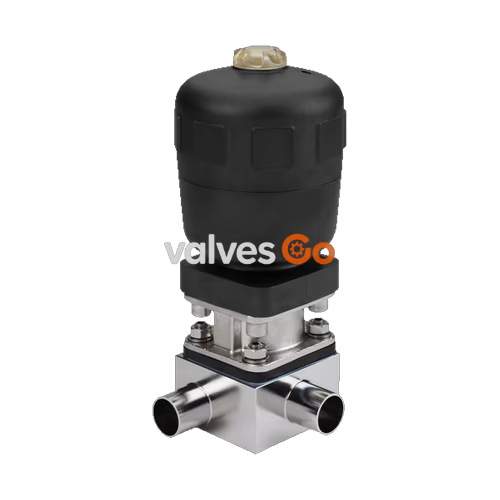
BURKERT 333947 (Type 2032) is an externally controlled 3/2-way pneumatic T-diaphragm valve designed for zero-deadleg branching, sampling, and distribution in hygienic and ultra-pure fluid systems. The unit combines a pneumatically operated PPS (polyphenylene sulphide) piston actuator, a PTFE diaphragm backed by an EPDM cushion, and a precision-machined stainless steel block T-body. Configured under Control Function A, the valve remains normally closed by internal spring force at rest, providing bubble-tight shut-off up to 10.00 bar static operating pressure. It handles process temperatures from -10 °C to +130 °C and withstands steam sterilisation cycles up to +140 °C for 60 minutes.
Engineered specifically for hygienic loop installations, the main pipeline connection (Port 1) features a 2-inch weld end conforming to ASME BPE and DIN 11866 Series C (outer diameter 50.8 mm, inner diameter 47.5 mm, wall thickness 1.65 mm). The branch weir matches diaphragm size 15 mm, reducing hold-up volume and stagnation zones. Internal fluid-contact surfaces achieve Ra ≤ 0.38 µm through electropolishing (or Ra ≤ 0.5 µm mechanical polish), ensuring full Clean-in-Place (CIP) and Steam-in-Place (SIP) compatibility for biotechnology, pharmaceutical, food, and beverage processes.
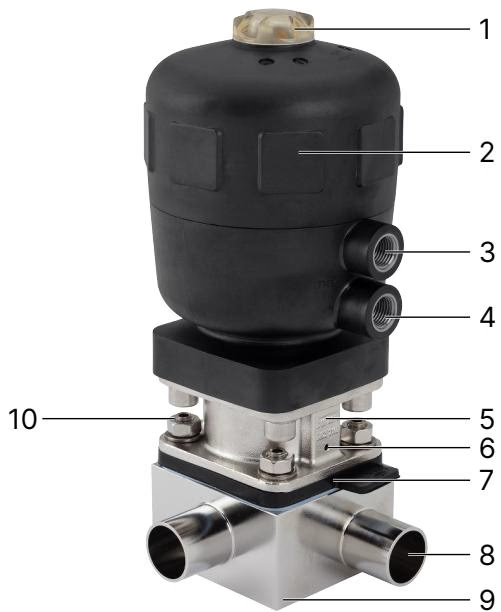
Type 2032 operates via a pneumatic piston mechanism acting on a flexible diaphragm seal against an internal body weir. For Control Function A (normally closed), integrated compression springs maintain continuous downward closing pressure on the piston, spindle, and compressor. This keeps the diaphragm firmly seated across the weir in the unpressurised state. When pilot air between 5.0 and 7.0 bar is admitted into the lower control port, pneumatic pressure overcomes the spring pack to lift the spindle and open the branch passage.
The T-valve design routes the primary process media through the main run without cross-sectional disruption, while the branch port allows diversion or sampling directly at the pipe wall. The actuator body includes an integrated optical position indicator underneath a transparent polysulfone cap, displaying open and closed positions clearly during plant operation.
| Technical Parameter | Specification / Value |
|---|---|
| Type / Article Number | Type 2032 / 333947 |
| Circuit Function | 3/2-way, Control Function A (NC, normally closed by spring force) |
| Diaphragm Nominal Size (DS) | 15 mm |
| Main Run Size (Port 1) | DN 50 / 2" (Outer Ø 50.8 mm, Inner Ø 47.5 mm, Wall 1.65 mm) |
| Pipe Standards | ASME BPE / DIN 11866 Series C |
| Valve Body Material | Stainless steel block material 1.4435 (DIN EN 10088) / 316L (ASTM A479) |
| Actuator Housing Material | PPS (Polyphenylene sulphide, autoclavable) |
| Diaphragm Material | PTFE with EPDM backing cushion (Type EA) |
| Piston Seal Material | FKM (Fluor rubber) |
| Operating Pressure Range | 0.00 bar to 10.00 bar (PN 16 / Class 150) |
| Pilot Pressure Range | 5.0 bar to 7.0 bar |
| Medium Temperature | -10 °C to +130 °C (Steam sterilisation max. +140 °C for 60 min) |
| Ambient Temperature | +5 °C to +140 °C (for PPS actuator) |
| Pilot Air Connection | G 1/4 female thread |
| Wetted Surface Quality | Internally electropolished Ra ≤ 0.38 µm (externally Ra ≤ 1.6 µm) |
| Certificates Included | Manufacturer test certificate 3.1, Factory certification 2.1 Membrane |
| Conformity & Compliance | FDA 21 CFR 177, USP Class VI, EC Regulation 1935/2004, 3-A Sanitary standard |
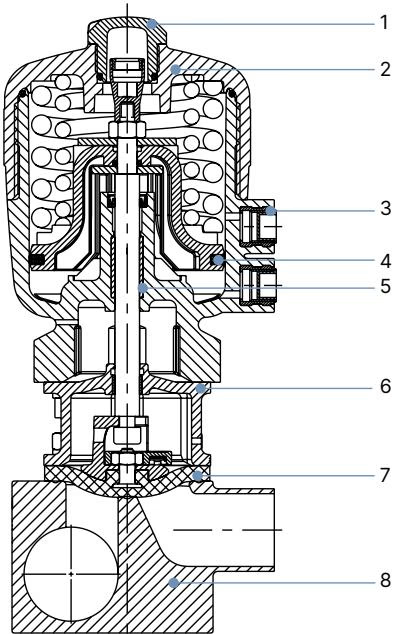
| Item No. | Component | Material Specification |
|---|---|---|
| 1 | Transparent cap | Polysulfone (PSU) |
| 2 | Actuator cover | Polyphenylene sulphide (PPS) |
| 3 | Pilot air ports | Stainless steel 1.4305 (G 1/4 thread) |
| 4 | Piston seal | FKM fluor rubber |
| 5 | Socket | Sinter metal |
| 6 | Intermediate interface / Bonnet | Stainless steel 1.4404 / 1.4308 |
| 7 | Diaphragm | PTFE with EPDM backing membrane (EA) |
| 8 | T-Valve body | Stainless steel block 1.4435 / 316L |
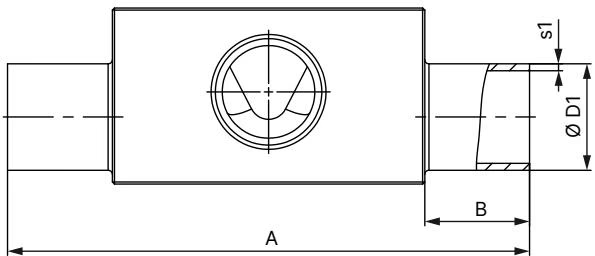
For article 333947 with diaphragm size 15, the welded T-body corresponds to product key pairing SODI-SA92 (DN 50 to DN 15) under ASME BPE / DIN 11866 Series C:
| Dimension Code | Description | Value (mm) |
|---|---|---|
| Ø D1 | Main pipe outer diameter (Port 1) | 50.80 mm |
| s1 | Main pipe wall thickness | 1.65 mm |
| Ø D2 | Branch pipe outer diameter (Port 2) | 12.70 mm |
| s2 | Branch pipe wall thickness | 1.65 mm |
| A | Total face-to-face body length | 113.0 mm |
| B | Main weld stub length | 30.0 mm |
| C | Height from main axis to branch face | 71.70 mm |
| E | Branch weld stub length | 20.0 mm |
| F | Distance from center to outer body face | 100.0 mm |
| G | Body width | 64.0 mm |
| H | Body height profile | 35.0 mm |
| I | Offset dimension | 21.5 mm |
Actuator dimensions for diaphragm size 15 (actuator size 63 / E) include outer diameter Ø A of 80 mm, clearance C of 52 mm, pilot port K of G 1/4, and overall actuator height H of 154 mm.
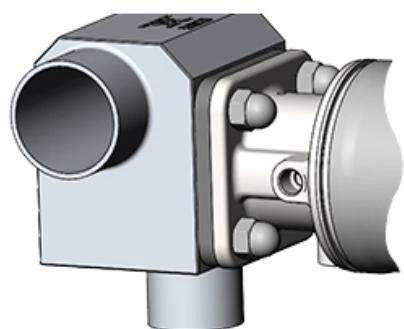
In circular loop installations, mount Type 2032 with the actuator directed upwards or inclined according to system drainage requirements. Orient the bonnet such that one of the relief leakage detection bores is positioned at the lowest physical point.
Critical Pre-Welding Instruction
Before welding the stainless steel block valve body into the pipeline, the pneumatic actuator and diaphragm must be completely unbolted and removed. Excessive welding heat transferred through the valve seat will degrade the PTFE/EPDM seal and distort internal actuator components.
The PPS actuator mechanism is maintenance-free under normal operating conditions. Routine inspection requires periodic visual checks of the bonnet relief bore for fluid leakage, signalling diaphragm wear.
Diaphragm Re-Torquing Interval
After the initial steam sterilisation cycle, or following maximum 100,000 switching operations, re-check and tighten all body screws crosswise. Muddy or abrasive media necessitate shorter inspection intervals.
When replacing the diaphragm:
| Diaphragm Size | EPDM / FKM Torques | PTFE / Advanced PTFE / GYLON Torques |
|---|---|---|
| DS 8 | 2.0 Nm | 2.5 Nm |
| DS 15 (Article 333947) | 3.5 Nm | 4.0 Nm |
| DS 20 | 4.0 Nm | 4.5 Nm |
| DS 25 | 5.0 Nm | 6.0 Nm |
| DS 40 | 8.0 Nm | 10.0 Nm |
| DS 50 | 12.0 Nm | 15.0 Nm |
All specified tightening torque values have an engineering tolerance of +10%.
Type 2032 integrates directly with decentralized automation units for position monitoring and distributed pilot control:
Explore similar products in our catalog