
Stainless Steel Case

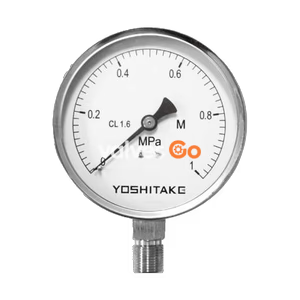
Armstrong PCB Series Pressure Gauge includes three models: PCB (Dry-Bottom General Purpose), PCS (Dry-Bottom Steam Type), and PSS (Liquid-Filled Steam Type). All three share Φ100 dial, Class 1.5 accuracy, IP55 protection rating, and identical dimensions, with ring tube and needle valve included. PCB is designed for general industrial environments, while PCS and PSS feature stainless steel movement and Bourdon tube rated to 300°C. PSS additionally uses glycerin filling to dampen pointer vibration for clear readings in high-vibration environments.
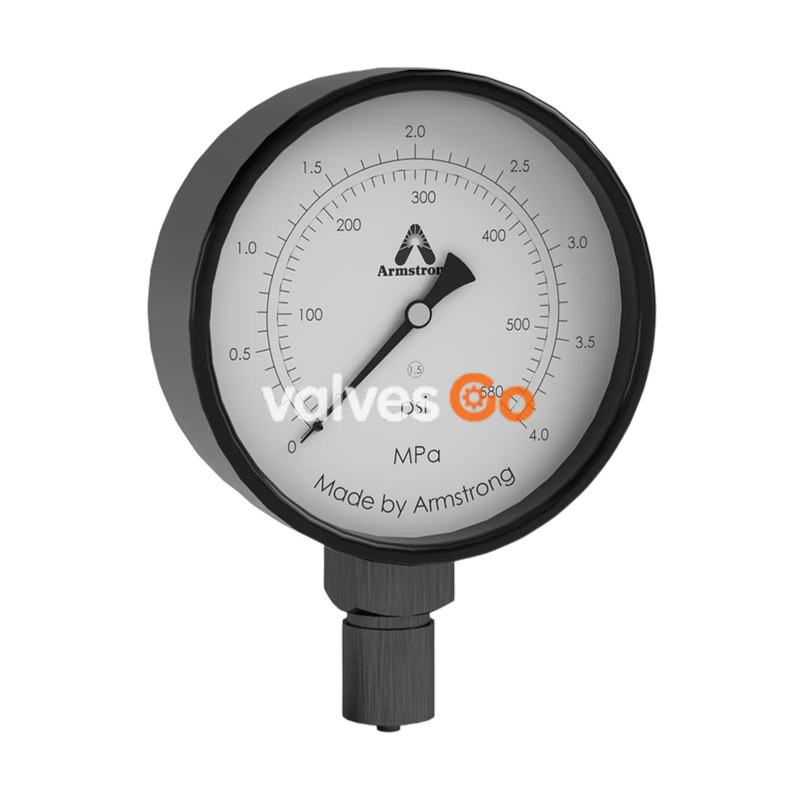
Armstrong PCB Series Pressure Gauge includes three models designed for different industrial applications:
All three models are equipped with ring tubes and needle valves, feature a 100mm dial diameter, Class 1.5 accuracy, IP55 protection rating, and identical dimensions. Suitable for pressure measurement of non-explosive, non-crystallizing, non-solidifying liquids or gases in petroleum, chemical, metallurgical, steel, food, and other industries.
Included Accessories
All three pressure gauge models include ring tube and needle valve as standard. When used with steam or other hot gases, the ring tube and needle valve MUST be installed to ensure measurement accuracy and equipment safety.
| Parameter | Dry-Bottom General (PCB) | Dry-Bottom Steam (PCS) | Liquid-Filled Steam (PSS) |
|---|---|---|---|
| Accuracy Class | Class 1.5 | Class 1.5 | Class 1.5 |
| Measurement Range | 0~1.0 / 0~1.6 / 0~2.5 / 0~4.0MPa; extended ranges available | Same as left | Same as left |
| Working Pressure | Static load: up to 3/4 of full scale; Alternating load: up to 2/3 of full scale; Short-term: up to full scale | Same as left | Same as left |
| Normal Operating Temp. | -40°C ~ 70°C | -40°C ~ 300°C | -5°C ~ 300°C |
| Protection Rating | IP55 | IP55 | IP55 |
| Dial Diameter | Φ100 | Φ100 | Φ100 |
| Connection | 1/2 BSPT | 1/2 BSPT | 1/2 BSPT |
| Fitting Thread | M20×1.5 (Brass) | M20×1.5 (304SS) | M20×1.5 (304SS) |
| Type | Model | Range |
|---|---|---|
| Dry-Bottom General | PCB-1.0 / PCB-1.6 / PCB-2.5 / PCB-4.0 | 0~1.0 / 0~1.6 / 0~2.5 / 0~4.0MPa |
| Dry-Bottom Steam | PCS-1.0 / PCS-1.6 / PCS-2.5 / PCS-4.0 | Same as above |
| Liquid-Filled Steam | PSS-1.0L / PSS-1.6L / PSS-2.5L / PSS-4.0L | Same as above |
Extended Range Options
In addition to standard ranges, all three models are available in lower range options (0~0.1 / 0~0.16 / 0~0.25 / 0~0.4 / 0~0.6MPa). Please refer to the Installation & Maintenance Manual for the complete model table when ordering non-standard ranges.
| Component | Dry-Bottom General (PCB) | Dry-Bottom Steam (PCS) | Liquid-Filled Steam (PSS) |
|---|---|---|---|
| Instrument Housing | Carbon Steel Black-Sprayed Snap-Fit Cover | Carbon Steel Black-Sprayed Snap-Fit Cover | SS Natural Color Snap-Fit Cover |
| Instrument Movement | Copper | Stainless Steel | Stainless Steel |
| Instrument Glass | Flat Instrument Glass | Flat Instrument Glass | Flat Instrument Glass |
| Bourdon Tube | Phosphor-Bronze Soldered (Tin) | Stainless Steel TIG Welded | Stainless Steel TIG Welded |
| Fitting | Brass M20×1.5 | 304SS M20×1.5 | 304SS M20×1.5 |
| Filled Liquid | None (Dry-Bottom) | None (Dry-Bottom) | Glycerin |
| Ring Tube | 304 Stainless Steel | 304 Stainless Steel | 304 Stainless Steel |
| Needle Valve | 304 Stainless Steel | 304 Stainless Steel | 304 Stainless Steel |
Key Differences
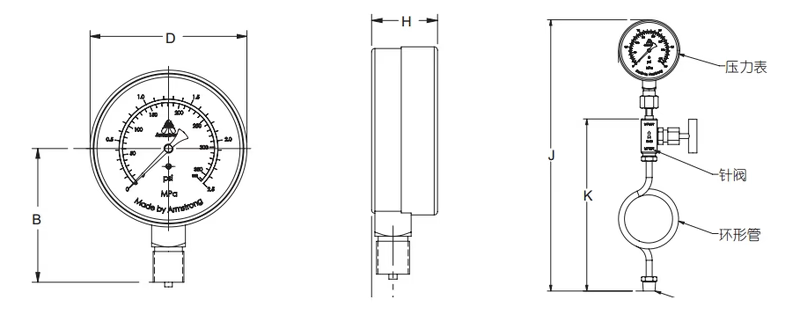
| Series | D | A | B | H | J | K |
|---|---|---|---|---|---|---|
| PCB / PCS / PSS Series | 102 | 13 | 87 | 40 | 451 | 286 |
All three models share identical dimensions and are interchangeable in installation.
As with all test equipment, the Armstrong pressure gauge is a precision measuring instrument, so special care must be taken during installation and use to ensure its reliability. When used with steam or other hot gases, the pressure gauge MUST be installed with a ring tube and needle valve.
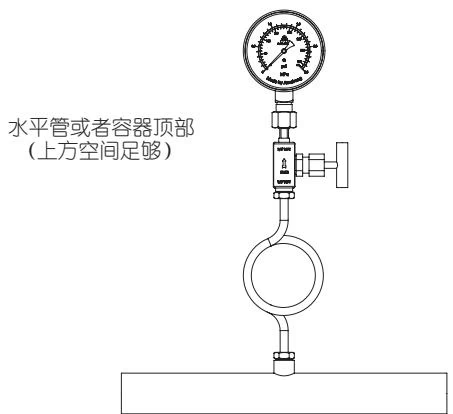
Installation Key Points:
When ordering, please specify the following information: